Education

Education

Dancing the Neighbourhood is an after-school activity for children aged 6 to 12, held on Tuesday afternoons at Museo CA2M.  A space for moving between ideas, improvising, taking shortcuts, changing direction, looking closely and finding a thousand other ways to move with the museum, the neighbourhood and everything that happens in between.
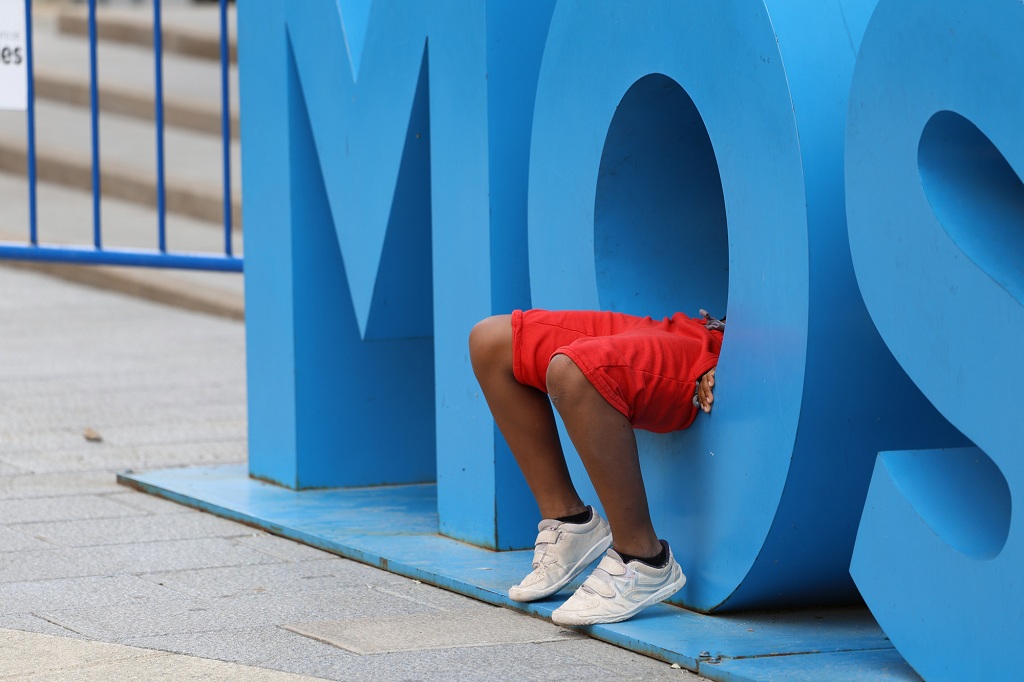
Can a city be danced? Can a museum shake, sway or slide a little out of place? What happens when we move between screens, classrooms, corridors, squares and unexpected encounters?

These are some of the questions that will accompany Dancing the Neighbourhood, our Tuesday afternoon after-school activity at Museo CA2M throughout the 2026–2027 school year.

In this small community, there is room for curiosity, detours and unexpected ideas. A place to try things out, change our minds, look closely, make decisions together and discover what happens when we move as a group.

This year, we will once again explore the museum and its surroundings, ready to take a second look at things that seem familiar. We will glide through galleries, corners, streets and squares, paying attention to what moves, what remains and everything that emerges in between, while approaching art as a tool for asking questions, imagining other futures, unsettling certainties and building knowledge together.

Over the year, we will cross paths with artists who will share their interests, questions and ways of working with the group. Each encounter will bring new points of reference, new games and different ways of approaching what we do. It will also open up new ways of understanding the body, creativity and dance, enriching our shared journey with different perspectives.

Dancing the Neighbourhood is an after-school activity for children aged 6 to 12, held on Tuesday afternoons at Museo CA2M. A space for moving between ideas, improvising, taking shortcuts, changing direction, looking closely and finding a thousand other ways to move with the museum, the neighbourhood and everything that happens in between.

Throughout the school year, some sessions will also be open to family and friends. These sessions will offer a glimpse into what happens each week, with opportunities to take part in some of the activities and experience first-hand the ideas, questions and discoveries that unfold over the course of the year.

The activity will be led by Baivén, a cultural mediation collective that uses the performing arts to encourage the sharing of experiences, perspectives and knowledge on an equal footing, while fostering critical thinking.

You can sign up at any point during the school year. Places are subject to availability, and we will be delighted to welcome you whenever a place becomes available.


Activity type
Dates
FROM OCTOBER TO JUNE
Target audience
Entrance

Dancing the Neighbourhood is an after-school activity for children aged 6 to 12, held on Tuesday afternoons at Museo CA2M.  A space for moving between ideas, improvising, taking shortcuts, changing direction, looking closely and finding a thousand other ways to move with the museum, the neighbourhood and everything that happens in between.

Subtitle
AFTER-SCHOOL DANCE AND MOVEMENT WORKSHOP
Categoría cabecera
bailar el barrio
DANCING THE NEIGHBOURHOOD
More information and contact
Media footer

Photo: Sue Ponce.

Is it a cycle?
Disabled
Duration
17:30 - 19:00

At the start of each school year, we embark on a new artist residency project. This year, we will be joined by artist Lidia Toga, who will be working with the school’s two fourth-grade classes.

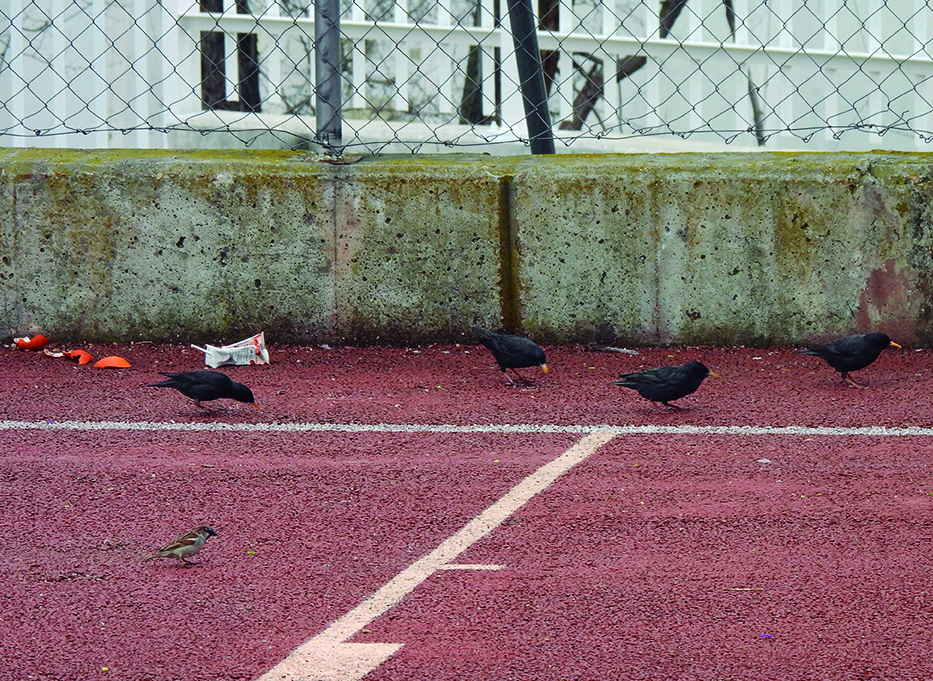
Every day, when break time ends, the playground at CEIP Federico García Lorca falls completely still. The children return to their classrooms and, for a brief moment, the playground is suspended in silence. That is when they begin to appear, one by one. They have been watching from the roof of the primary school building for some time, still but alert, as though waiting for a signal known only to them. Once the bell falls silent, they make their way down to the ground with purposeful steps, following the same choreography each day.

They approach the bins and carefully pull out biscuit packets, scraps of pastries and milkshake cartons. What the human creatures carefully placed in the bins during break time ends up scattered across the ground and turned into food. The school’s birds (magpies, wagtails, monk parakeets, pigeons, sparrows and starlings) feast while the children do multiplication and dictation exercises in their classrooms. This is how the birds find food in winter: by following the traces we leave behind.

This simple scene—a small, almost unnoticed gesture—is the starting point for the project we will share with Lidia Toga throughout the winter, spring, summer and autumn of 2026. Lidia walks slowly, letting her gaze linger where almost no one else thinks to look. She watches the birds patiently and draws them with the same care: every line is a way of listening to them, of learning how they inhabit the world. We want to take this everyday coexistence between people and birds—so close to us, yet so easily overlooked—as our starting point, and learn to observe it with greater responsibility and care.

The playground is a territory where many forms of life coexist, although the pace of the school day often leaves us little time to stop and notice them. We want to open up this space: to recognise those who inhabit it and help the children understand how our actions affect the cycles and needs of those who fly, walk or hide among the branches.

Lidia Toga (Madrid, 1980) is an artist specialising in illustration, painting and mural art, with a career spanning almost two decades. Since 2018, she has been researching biodiversity and the relationship between rivers and cities, building an extensive archive around the Manzanares and Río de Oro in Melilla. Her work has resulted in exhibitions, publications, works on paper and community projects, including a large-scale mural in Melilla. Since 2010, she has led workshops for children at venues including La Casa Encendida and schools, as well as in her own studio by the river. Her practice centres on interspecies coexistence and rethinking the place of humans within nature. She advocates careful observation and a reciprocal relationship with ecosystems and their inhabitants.

Entrance

As we do every academic year, we are launching a new artist-in-residence programme. This year we will be working with the artist Lidia Toga, who will be working with the two Year 4 classes.

Subttitle
Artist residency by Lidia Toga at Federico García Lorca infant and primary school (CEIP)
Header category
residencia FGLorca
THE CLASS FLEW BY
Media footer

Photo: Lidia Toga.

Type Thinking / Community
Topics Educational Community
Hide main image
Disabled
Topics
Is it a cycle?
Disabled

“Out of the mud... these seams” is a morning workshop at the Museo CA2M where we invite groups of pre-school and primary school children to come and share stories connected to other forms of knowledge and transmission, using experiences they already practise: gestures, listening, play, telepathy, imagination, dreams...

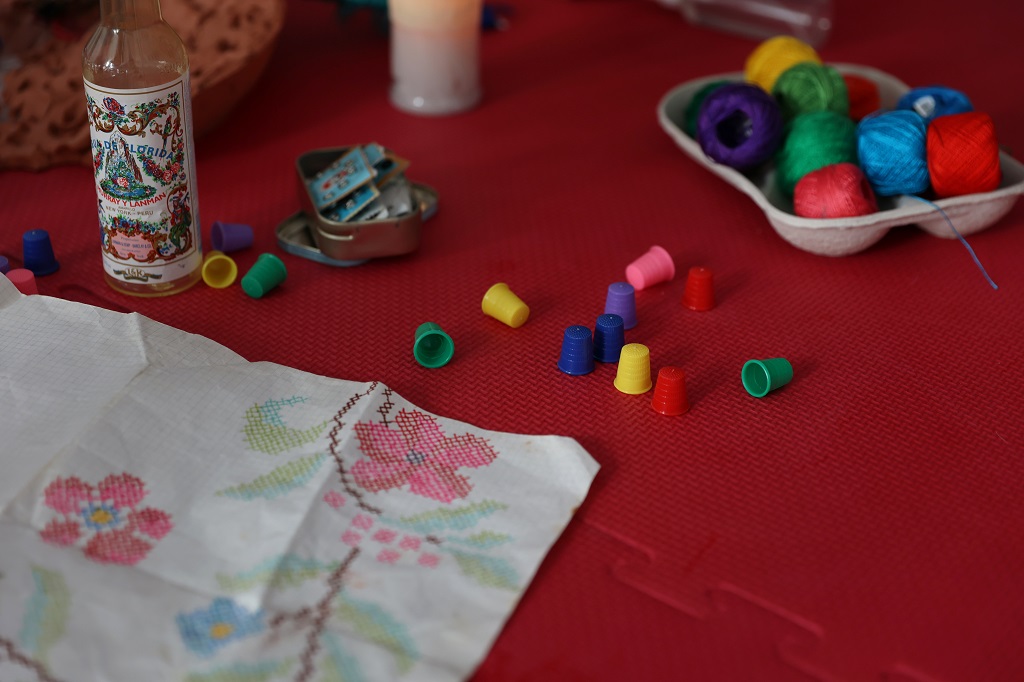
The stories are shared in the workshop without the need for words. Sometimes they emerge in the form of stitches, sometimes in gestures or silences. The children explore ways of learning and remembering that are not always taught but are felt. The workshop and the exhibition space are a place to come together, imagine and listen with the body, a place where the ordinary is transformed into the extraordinary, and art emerges without anyone naming it.

Adriana Reyes (anthropologist and creator in the living arts field) and Gregoria Batalla Batalla (teacher at the infant school Zaleo, History of the Americas graduate and revolutionary in the art of educating) know a great deal about all of this, which is why we’ve invited them to design this workshop in which the children will turn something small into a new creation; where the body, collective action and other contemporary art forms will be harnessed to create something wonderful out of something small.

Activity type
Dates
FROM FEBRUARY TO JUNE
Registration
-
Acceso notas adicionales

Maximum 25 people

Entrance

“Out of the mud... these seams” is a morning workshop at the Museo CA2M where we invite groups of pre-school and primary school children to come and share stories connected to other forms of knowledge and transmission, using experiences they already practise: gestures, listening, play, telepathy, imagination, dreams...

Subtitle
WORKSHOP FOR PRE-SCHOOL (AGES 4 AND 5) AND PRIMARY SCHOOL CHILDREN
Categoría cabecera
Barros
OUT OF THE MUD 2025–2026
More information and contact
Media footer

Picture: Sue Ponce.

Is it a cycle?
Disabled
Duration
TUESDAY 10:30 a.m. - 12:30 p.m.

It was already super-late and there was still plenty of light. Right, right. There was plenty of light. We also talked about this because, of course, it was so far west and it was very rare, as if people who were already deep into the night were sending us photos of their darkness. But we remained in broad daylight. Right. But there was no sun. It was daytime. Right. Plus, the light was really fragmented. Right, right. Like haze in the background because there was no mist nearby. It was like a kind of warm mist. Of course. I mean, the time came when you couldn’t see the horizon. The horizon was erased. Right, right, like when you looked it seemed like the horizon line had disappeared. Like it had been erased with Photoshop. Of course. This idea that the sky merges with the sea. Right. But like just a part of it. Right. Of the horizon line. Not all of it. That’s right. And like a speck that was the sailboat, and we were going there, that was really strange, right? You could see a bit of light in part of the sea, but then there was nothing. Of course. It was a place of mirages. So then we looked and we all said that it’s not going to cross. Yes, yes, it’s going to cross. No, it’s impossible, it's going to wend, it's going to wend, because that was the edge, and beyond the sea falls away. Maybe that’s why the line couldn’t be seen, because we were already on the other side.

EDUCATIONAL PROGRAMME 2024-2025

Preschool and primary school

Secondary school

Teacher training

Youths

Families

Everyone


Entrance

Here you’ll find all the educational programming and activities of the CA2M Museum for everyone: families, young people, teacher training and groups of preschool, primary, secondary and baccalaureate students.

Header category
PROGRAMA EDUCATIVO 2025
EDUCATIONAL PROGRAMME 2024-2025
Type Thinking / Community
Hide main image
Disabled
Is it a cycle?
Disabled

At one of our meetings last school year, Goya told us that her [AS1] school, Zaleo, would no longer have students aged three to six. This news heralded the end of an educational model that has vanished over time, just like many other schools for children aged birth to six.

Based on this revelation, our conversations revolved around how this change not only affected schools but also community life. We nostalgically recalled parks that used to ring out with children’s laughter and unexpected discoveries in the morning: carefully tracing the route taken by an ant, looking at the shape of leaves, strolling through the market and being fascinated by its rhythm. We imagined how with larger student-to-teacher ratios per classroom, schools could no longer allow themselves the luxury of spending the mornings on outdoor activities. This scene, which is common yet exceptional, will never be repeated.

And we wondered about the consequences of this. What learning opportunities were we depriving the children of? We want to keep the image of young explorers on the streets before it disappears completely, valuing the lessons they can learn and discoveries they can make in parks, squares and markets.

This academic year 2024–2025, we are carrying on with the project of partnering with the EnterArte collective. This project, which focuses on education for children aged birth to six, aspires to transform our museum and classrooms into laboratories of experimentation about education and art. We want to strengthen our bonds through gatherings and activities that connect us with the essence of childhood.  With this partnership, we are seeking to make the museum a more accessible space adapted to this age group.

Dates header text
THE ENTIRE SCHOOL YEAR
Entrance

This project, focused on education for children from 0 to 6 years of age, aims to transform the museum and classrooms into laboratories for experimentation on education and art.

Subttitle
0–6 RESEARCH PROJECT
Header category
PROYECTO_0-6
A PIECE OF LINT, A SPECK, A SEQUIN ON THE GROUND THAT ALMOST NOBODY SEES
Media footer

Picture: Sue Ponce.

Type Thinking / Community
Hide main image
Disabled
Is it a cycle?
Disabled

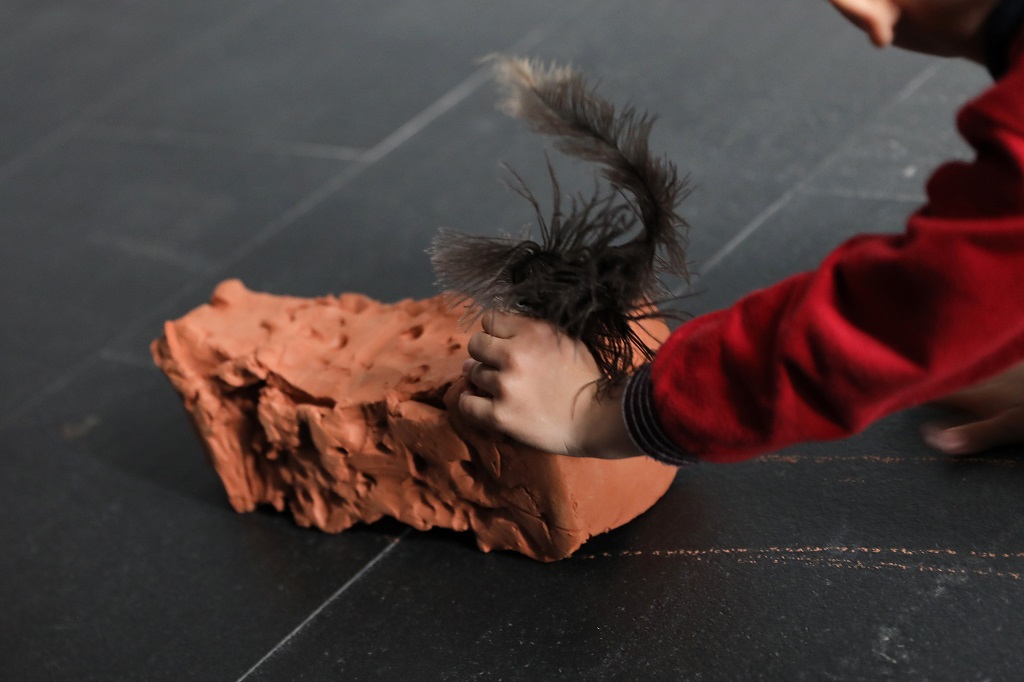
There are many pottery pieces in the CA2M Museum workshop that were shaped by the groups that visited us in 2022. They were very carefully fired, each in a school’s kiln. There they released all the water they contained, and when it evaporated, it dispersed through the air of Móstoles. There are also legions of small clay pieces that harbour the sorrows brought by the children who came with their class to the ‘De aquellos barros’ workshop last school year.

Clay contains four elements: soil, water so it can be shaped, air to dry and fire to be baked. Nana Baruque, one of the oldest goddesses of Candomblé, is the goddess of mud, clay, the marshes, drizzle. She welcomes you when you are born and bids you farewell when you die.

Tuesday mornings, on the Nana celebration day, the CA2M Museum activates a ritual that choreographs the entire session. In this workshop, where the children will be the mediums, we invoke the power of clay and the aliveness of objects. This workshop is a space of imagination, creation and magic, such necessary ingredients in our learning spaces.

We invite preschool and primary school classes to participate in this activity, in which we imagine a response to the question: What can we do with that clay? Leave school and enter a museum to touch, change, break, make noise and soften.

Adriana Reyes (anthropologist and creator in the field of the live arts) and Goya Batalla (teacher at Escuela Infantil Zaleo with a degree in American History, and a provocateur in the Art of Educating) know a lot about this. We have invited them to design this workshop in which children will make a new creation from something small, where the body, collective action and other contemporary art forms will be put into practice to turn something small into something extraordinary.

Activity type
Dates
JANUARY - JUNE 2025
Acceso notas adicionales

COMIENZOEN ENERO DE 2025

Entrance

We invite infant and primary classes to participate in this workshop to invoke the power of clay and the liveliness of objects, where children will be mediums. This workshop is a stronghold of imagination, creation and magic, so necessary in our learning spaces.

Categoría cabecera
barros
making a mountain out of a molehill
More information and contact
Media footer

Picture: Sue Ponce.

Is it a cycle?
Disabled
Duration
TUESDAY 10:30 - 12:30

Last school year we worked on a project that involved the UFIL Pablo Neruda and the children’s residence of Móstoles. The goal was to create our own space in the residence’ garden that catered to the children’s wishes. Throughout the entire year, we partnered with the designer Curro Claret and the carpentry group at the UFIL to develop the prototype of a modular structure that the children could transform into whatever they want: a house, a stage, a platform for sleeping, a cave or even a swing.

In early summer, we completed the project with an opening party for the house. It was exciting to watch how the children made it their own as they explored the space. That has become a starting point, an excuse to take yet another step. We want to invite artists and creators to intervene in this space in order to resignify it as a place of work and research along with the children. This is only the beginning.

Soft House is a collaborative project with the children’s residence of Móstoles that aims to serve as an invitation to reconsider what a house means. It is a place to reflect on the concept of the nuclear family, to challenge it and suggest new ways of designing and intervening in our surroundings.

Dates header text
TODO EL CURSO ESCOLAR
Entrance

Casa Blanda is a collaborative project with the children's home in Móstoles that seeks to be an invitation to rethink what a house means.

Header category
casa blanda
SOFT HOUSE. PARTNERSHIP WITH THE MÓSTOLES CHILDREN’S RESIDENCE
Media footer

Picture: Sue Ponce.

Type Thinking / Community
Topics Educational Community
Hide main image
Disabled
Topics
Is it a cycle?
Disabled

For some years now, the museum has worked closely with García Lorca school in Móstoles. Over this time, we have witnessed its teachers’ incredible commitment, who understand that educational practice is primarily a form of activism and a commitment to the surroundings and to the community near the school.

One clear example of this commitment is the school radio station, an initiative that involves the entire school. This radio station has not only allowed students to create their own content but has also become a mouthpiece for our museum and its programmes.

This academic year, we want to work with the school team to create a new project that inspires us and encourages us to think in the long term by establishing a shared language through which our two institutions can engage in dialogue and grow together.

Over these years, we have talked about the spaces around the school, their boundaries and their potential as new places of learning. Inspired by this vision, we have decided to develop an open classroom project using the school’s outdoor areas and vacant lots that connect it to the neighbourhood. It is a pedagogical approach based on self-building and play to create a space of encounter where students, teachers, families, and we ourselves can share, learn and live.

Dates header text
THE WHOLE SCHOOL YEAR
Entrance

For years, the museum has maintained a close collaboration with the Federico García Lorca school in Móstoles.

Header category
garcia lorca
FIELDWORK. PARTNERSHIP WITH CEIP FEDERICO GARCÍA LORCA
Media footer

Picture: Sue Ponce.

Type Thinking / Community
Topics Educational Community
Hide main image
Disabled
Is it a cycle?
Disabled

NIBBLES OF REALITY

‘If you’ve ever dreamed it, it’s real. If you’ve ever felt it, it’s real. If you’ve ever experienced it, was it real? Are the place you occupy in the world and that way you think no longer the same as before? Do you get lost in the onslaught of information today? Do you no longer know whether that voice in your head is stable? Take a nibble of reality before all that gets to you! Perhaps you’re wondering how you got here; I don’t know. I don’t even exist; I’m just a voice that comes to life in your head through words. But from there I can invite you to explore dissociation, the construction of the story and illusion, and that may even include a panoramic visit to the uncanny and other places yet to be deciphered. And no prior experience is needed! Liminal instructions to play in reality: reality twists. Reality expands. Reality blurs. Reality breaks. The reality we build. Now we’re where things continue (talking through the voice that reads in your head), a group (and perhaps, too, an unreachable place) made up of ex-under-twenties which is generated from restlessness and curiosity through the museum and its practices.’

Where Things Continue is a group made up of former participants in the youth programmes with an interest in culture, art and community work. The project aims to redefine the relationships with the museum by fostering its members’ self-management and getting them involved in building the programming targeted at young people.

Dates header text
ALTERNATE SATURDAYS UNTIL JUNE
Directed to
Entrance

Where Things Go On is a group formed by former participants of youth programmes with an interest in culture, art and community work.

Subttitle
RESEARCH GROUP
Header category
sub21
WHERE THINGS CONTINUE
Media footer

Picture: Sue Ponce.

Type Thinking / Community
Hide main image
Disabled
Duration
17:30 - 20:30
Is it a cycle?
Disabled

The universe is an indomitable force that cuts through our very existence and shapes our spirit. We are sorceresses, clairvoyants and mediums from birth, experts in the power of divination, clairvoyance and communication with the great beyond. If you’re reading this, fate and cosmic vibrations attracted you to this page so you could communicate with us. We can channel the essence of elements to attract positive energy and stave off the evil eye. We will reveal the answers to your existential questions and attract balance to your life to fill it with light and spiritual wellbeing. Request information, no strings attached.

You’re not on the wrong page. Cultural mediation can have a bit of divination, witchcraft and esotericism about it. Mediation for Five Handrails is a collaborative project between AMECUM and the CA2M Museum throughout the 2023-2024 academic year, where we rethought mediation itself in its context by putting the mediator’s body in the centre, amidst so many objects and words. This project is also regarded as an inquiry revolving around two lines of action at AMECUM: reflection and experimentation in mediation, good practices and other ways of seeing it; and bringing visibility and recognition to the figure of the cultural mediator.

Through this announcement, we want to invite you to the project presentation, where we’ll share the results of the inquiry conducted by AMECUM, which started with an invitation from the CA2M Museum to conduct visits to the exhibitions. Thus, we wanted to engage in an open act/performance/ritual to freeze time and record the fleeting footprints of our mediations, which still exist as living spectres.

Dates header text
12 June
Directed to
Entrance

Through this announcement, we want to invite you to the project presentation, where we’ll share the results of the inquiry conducted by AMECUM, which started with an invitation from the CA2M Museum to conduct visits to the exhibitions. Thus, we wanted to engage in an open act/performance/ritual to freeze time and record the fleeting footprints of our mediations, which still exist as living spectres.

Associated activities
Header category
Amecum
MEDIATIONS FROM THE GREAT BEYOND
Media footer

Picture: AMECUM (Mar Sáenz-López, Ximena Ríos, Jesús Morate, Alex Martínez y Ana Folguera).

Type Thinking / Community
Hide main image
Disabled
Duration
19:00- 21:00
Is it a cycle?
Disabled