Activity

Activity

The requisite to participate will be reading the texts before each session, where you will be expected to participate.

Moderated by BOYA x Seminario Euraca. Ignacio Redrado, Paula Pérez-Rodríguez and Erea Fernández.

This course’s educational activity programme is oral. If you are interested in this activity, write to us at educacion.ca2m@madrid.org or call us on 912760227 and we’ll tell you all about it.

You can sign up HERE

This project is part of the series of language workshops by the A.C. Banda Editorial Silvestre. Organised by BOYA~célula in collaboration with Seminario Euraca.

Activity type
Dates
Alternate Thursdays from October 28 to June 23
Target audience
Acceso notas adicionales

Aforo máximo: 15 personas

Categoría cabecera
Grupo de lectura 2022
WHEN WILL YOU COME TO SEE US? READING GROUP
More information and contact
Is it a cycle?
Disabled
Duration
17:00 – 20:00

The Huerto en la terraza of the CA2M has been holding workshops for almost a decade. During this time, we have lived through an active process involving the participation of many different people, all of whom have made it a meeting spot based on teamwork and shared knowledge.

Since its beginnings, the Huerto en la terraza has been a space whose aim is to go beyond just being a school of organic agriculture; it had to form a community. It has far exceeded this expectation, accumulating myriad experiences, learning, collective stories and community links around it, all of which make us proud to have such a space as this in Móstoles, one that is already a benchmark beyond our municipality’s borders.

Today, the community of the Huerto en la terraza of the CA2M faces the challenge of opening up to new people without losing the drive to carry out research and experimentation to motivate those who are already a part of it. For this reason, during this course we will provide an opportunity to those interested in starting out in the field of organic agriculture and permaculture, at its most basic levels, without forgetting the needs and learning pace of those who have already participated in the past and who require other lines of experimentation that combine vegetable gardens, art and our immense capacity to create with our own hands. This year, the workshops will change their timeslot to Thursday mornings. We hope that this change will bring more people to our vegetable garden so we can continue to share and learn together.

Free admission with limited capacity.

In collaboration with Break the Cycle Transition Institute

For further information please visit actividades.ca2m@madrid.org or call 912 760 227.


WORKSHOPS IN THE GABRIEL CELAYA SCHOOL (5:00 TO 7:00 PM) 

23 September: How to start an organic vegetable garden 

Learn to set up a poison-free sustainable vegetable garden from scratch. 

30 September: Seeds: how to gather them and how to plant them

We will work on-site with seeds from our organic vegetable garden and learn to gather them and create our own seedbeds. 

7 October: Cultivating and reproducing aromatic herbs

Learn everything you need to know for planting, caring for, gathering, using and reproducing your own aromatic plants. 


WORKSHOPS AT CA2M THURSDAY (11:00 AM TO 1:00 PM)

21 October: Reproducing cuttings and other plants from the organic vegetable garden

Learn how to reproduce your vegetable garden’s plants so you can exchange them with your classmates and increase the variety of plants in this organic space. 

28 October. How to create a terrace vegetable garden 

Learn how to start a vegetable garden on your balcony. No matter how small, anything is possible. 

4 November: Autumn tasks in the vegetable garden

We will plant in autumn, while also learning together how to look after our organic vegetable garden.

11 November: Home composting workshop

Come and learn the art of home composting with us. 

18 November: How to make your own medicinal oils

We will use our terrace plants in order to extract their medicinal properties and make oils that can be used for common ailments. 

25 November: Natural Cosmetics Workshop I

We will create creams for common ailments in a simple way using easily-accessible products. 

2 December: Natural Cosmetics Workshop II

We will learn to make natural soaps. Original and personal alternatives for Christmas presents. 

9 December: Basketmaking workshop

What better way to accompany your homemade gifts than to put them in homemade baskets, made by you? 

16 December: Sustainable Christmas recipe workshop

Join us, yet again, in putting together a sustainable Christmas menu that is easy to prepare – and affordable for all budgets – that will delight your guests. 

Activity type
Dates
THURSDAY FROM 11:30 AM TO 1:30 PM
Target audience
Topics
Acceso notas adicionales

AFORO: 20 PERSONAS

Entrance

The Huerto en la terraza of the CA2M has been holding workshops for almost a decade. During this time, we have lived through an active process involving the participation of many different people, all of whom have made it a meeting spot based on teamwork and shared knowledge.

Categoría cabecera
HUERTO EN LA TERRAZA
HUERTO EN LA TERRAZA AUTUMN 2021
More information and contact
Media footer

Fotografía: Sue Ponce.

Is it a cycle?
Disabled
Duration
UNTIL DECEMBER 16

This autumn's cinema series is a celebration of the audio-visual media that is part of the Centro de Arte Dos de Mayo Museum’s public heritage. Our collections feature many pieces of video art encompassing the last decades of audio-visual history, both nationally and internationally. In recent years, we have also decided to make a strong commitment to promoting experimental and exhibition cinema, as we consider the moving image to be a fundamental heritage in present-day culture and, above all, because it is important to have a museum record of the great moment that film is currently experiencing in Madrid.

Dialectal Cinema is an ideal accompaniment to Dialecto CA2M. It will allow us to watch some of the most interesting films acquired in recent years in their authors’ own voices. In other words, it will follow the traditional cinema and colloquium format, but with exceptional artists.

Non-commercial cinema is a fundamental element for the opening of the CA2M Collection. Luis López Carrasco (Murcia, 1981) will open the cycle with The Future (2013), a film of unique generational importance. This was his first big hit before the acclaimed The Year of Discovery (2020). Another documentary film, Everyone likes bananas, brings Rubén H. Bermúdez (Móstoles, 1981) back to our museum, collectively addressing the day-to-day experience of blackness in Spain as part of an impressive community exercise. The Science fiction category will be represented by Ion de Sosa (San Sebastian, 1981), who adapted Philip K. Dick's Androids Dream of Electric Sheep into a dystopian Benidorm during low season.

Lois Patiño (Vigo, 1983) has been a leading voice in the field of exhibition cinema, a less narrative format that acts as a loop for exhibition spaces, over the last decade. In Shady Mountain, the viewpoint and light reveal the geological formation as a place of coexistence, a sublime place to live. Films by Alex Reynolds (Bilbao, 1978) defy conventional narrative by displaying the affective structures that glue viewers to the screen.

In the final session can chat with three quite different video artists. Ana Esteve (Agres, 1986) discusses cinema itself and its conventions in her films. In The Magic Screen she turns a city built on the East Coast of Spain, the Levante, which is still a potential dream, into an archaeological site. Cristina Garrido (Madrid, 1986) uses a cliché promotional documentary to explain a new kind of art. This film is shown at art fair stands and Garrido herself considers it to be another artistic genre altogether: just like painting, the art featured at the fair pavilion. Finally, Mar Reykjavik (Sagunto, 1995) reflects on the creation of identity through new technologies and the virality of networks. My body, my rules analyses the potential relationships and escapes resulting from viral challenges.

In addition to these dates, and for the duration of the CA2M Dialect exhibition, all the video pieces from the CA2M Collection and the ARCO Foundation Collection will be available for viewing in a cinema on the second floor of the museum. There, visitors can choose which piece they want to watch and enjoy the possibilities that the cinematographic medium offers for current artistic expression.​

Activity type
Dates
Del 28 de octubre al 2 de diciembre
Target audience
Entrance

This autumn's cinema series is a celebration of the audio-visual media that is part of the Centro de Arte Dos de Mayo Museum’s public heritage. Our collections feature many pieces of video art encompassing the last decades of audio-visual history, both nationally and internationally.

Descubre más
Subtitle
CINEMA IN THE CA2M COLLECTION
Categoría cabecera
El Futuro
DIALECTAL CINEMA
More information and contact
Media footer

Fotograma de El Futuro, Luis López Carrasco, 2014.

Is it a cycle?
Disabled
Duration
18:30 - 20:30

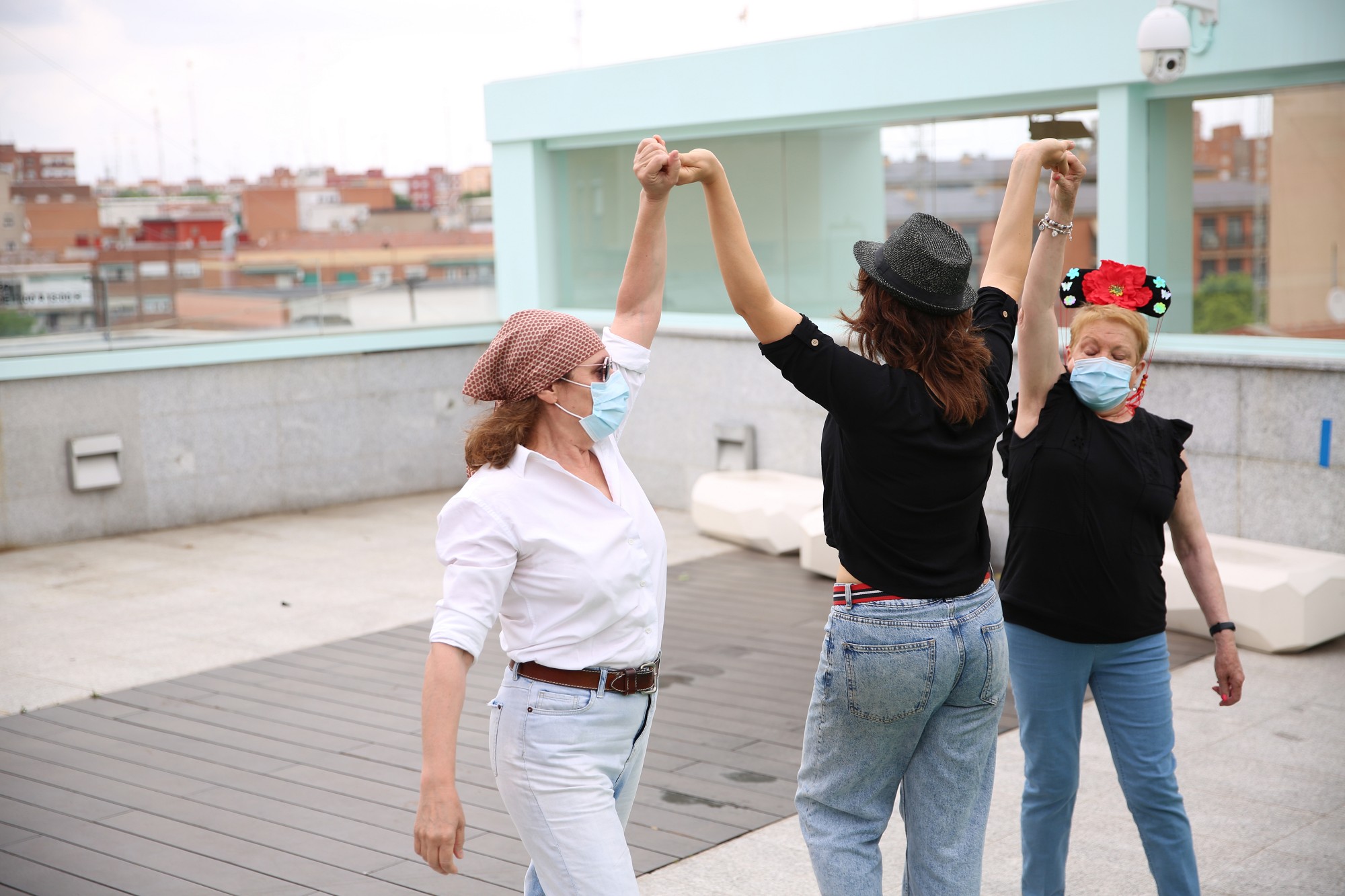
Extracurricular movement workshop.

This course’s educational activity programme is oral. If you are interested in this activity, write to us at educacion.ca2m@madrid.org or call us on 912760227 and we’ll tell you all about it.

You can sign up HERE

This activity is part of the series The Art of Happening. Performance workshops with Mónica Valenciano.

Activity type
Dates
MARTES DESDE EL 26 DE OCTUBRE AL 5 DE ABRIL
Target audience
Acceso notas adicionales

AFORO: 15 PERSONAS.

Entrance


Categoría cabecera
Bailar el barrio
THIS IS THE STORM CREATED BY THE SOUNDS OF THE SHOES BELONGING TO THE GIRLS WHO COME TO DANCE IN OUR NEIGHBOURHOOD
More information and contact
Media footer

Fotografía: Maru Serrano.

Is it a cycle?
Disabled
Duration
17:00 - 18:00

This course’s educational activity programme is oral. If you are interested in this activity, write to us at educacion.ca2m@madrid.org or call us on 912760227 and we’ll tell you all about it.

You can sign up HERE


Activity type
Dates
JUEVES ALTERNOS DESDE EL 4 DE NOVIEMBRE AL 16 DE JUNIO DE 2022
Target audience
Acceso notas adicionales

AFORO: 15 PERSONAS.

Categoría cabecera
UN CORO AMATEUR
AN AMATEUR CHOIR
More information and contact
Media footer

Fotografía: Sue Ponce.

Is it a cycle?
Disabled
Duration
17:00 - 20:00

International Seminar  May 20 to 23

May 23 Forum for Researchers and artists 
May 13 to Sept. 27 Exhibition

CA2M organizes the XVI Image Symposium including a conference and debate programme on the subject of Imagine_Historicize.

Within the framework of this programme, an open call is issued inviting participation of researchers and artists. The selected authors will introduce their projects to the public attending, during journeys dedicated to the Forum of the unpublished. Those projects will be published in the book of minutes of the Symposium.

The Image Symposium intended to be a place of discussion and reflection around issues relevant to the setting of the contemporary subject.

Within this frame, history and memory currently have a strength and visibility that goes beyond the academic sphere which constitute a social and cultural hot debate. The official History, single and linear, has been broken into parts to give rise to multiple memories, demands as a mean of identity and, also, as a set of political and cultural values.

Such proliferation of histories, sometimes incompatible, is the result of complex dynamics and societies ever more diverse that consider the past time through memories, remains and monuments as an archeological process ever open. For its part, the global cultures of the images produce a time and space in a continue present, where cohabit all geographies, discourses, disciplines, visual styles and historic periods. All of them, floating and available to reinvent pasts, presents and futures.

With all this, what is the capacity and ethic and political role of the production, retrieval (and destruction and occultation) of images in the construction of history and memory? How do historians use images and how do they face the digital era? How “other histories” transform the hegemonic history written by the modern states with cohesion desire? What visions of the present lie behind the images used by artists? What idea of the future? Those are some of the questions raised in the following journeys by means of lectures, debates from great specialists and a “CA2M Abierto” Forum, for researchers and artists.

CALL

CA2M organizes the XVI Image Symposium  including a conference and debate programme on the subject of Imagine_Historicize. Within the framework of this programme, an open call is issued inviting participation of researchers and artists. The selected authors will introduce their projects to the public attending during the journeys of the Forum of the unpublished. Those projects will be published in the book of minutes of the Symposium.

The Call aims to start a forum for debate to projects related to the questions raised before and also to other topics:

- Historians and images. Images: documents of historical evidence or problematic evidence in an irretrievable past?

- Images of memory. Impact of production and destruction of images in the process of constitution of history and memory.

- Other histories. New voices of history through images: imaginary stories.

Requirements: The proposals must include the registration form dully filled in.

- Project on Artistic Theory and Practice. It must be an unpublished project and must  have the DIN A4 size; in case of an artistic practice, it should have the presentation of a memory, dossier or portfolio. The investigation essays will have a range between 10 and 15 pages, doble space and Times New Roman 12. Images screening are permitted during lectures.

Projects, both in Spanish and English, are accepted

Uncompleted applications won´t  be accepted.

The selected authors who wish to attend the Symposium and reside outside the Region of Madrid may benefit from 150 € as travel expenses (the applicant may enclose in its application any relevant document supporting the proof of place of  residence  - eg. Resident permit, City Certificate of Registration, a photocopy of student card, electricity or gas bills...).

The documentation from non-selected projects could be collected during the days of the Symposium.

DOCUMENTATION REQUIREMENTS AND REGISTRATION PERIOD

The deadline for receipt of projects is April 15, 2009. Participant may submit the aforesaid documentation:

- By email: download form at  www.ca2m.org  and send, duly filled in, together with project (in a .doc or .pdf format) to actividades.ca2m@madrid.org. This e-mail address is being protected from spambots. You need JavaScript enabled to view it

- By mail, enclosing the duly filled in registration form together with the printed project (projects arrived later than April 15 will be discarded)

SELECTION

The directors of the Symposium will select a maximum of 10 projects. April 30 it will be published the list of selected participants in the CA2M web page. The selected participants will receive an express communication, which will state the date and time of his/her presentation at CA2M.

For further information  actividades.ca2m@madrid.org. This e-mail address is being protected from spambots. You need JavaScript enabled to view it   or at 91 276 02 27

It will be positively consider those applications that show rigor, creativity, interdisciplinary and   relevancy to the line of work detailed in the call. It won´t be taken into account  the order of registration nor the fact of having participated before in previous editions.

SCHEDULE

MAY 20

11,00 h. Opening  Hon. Minister of Culture and Sports , Mr. Santiago Fisas Ayxelà.
Presentation Ilma. Director General of Archives, Museums and Libraries, Dña. Isabel Rosell Volart.
Presentation Director of Centro de Arte 2 de Mayo, Ferran Barenblit.

11,15 h. Introduction to the Symposium. Mónica Portillo and Sergio Rubira, Directors of the XVI Image Symposium of the Region of Madrid.

12,00 h. Philippe-Alain Michaud. Art historian and curator of film at the Musée National d'Art Moderne, Paris.

16,00 h. Svetlana Boym. Professor of Slavic and Comparative Literature and Associate Professor at the School of Architecture and Design, Harvard University.

18,00 h. The Otolith Group: Anjalika Sagar (artista, comisaria y escritora, Londres); Kodwo Eshun (artista, escritor, DJ, profesor del Máster en Cultura Visual del Goldsmiths College, University of London).

JUE 21 MAY

11,00 h. Santu Mofokeng. Photographer, Johannesburg.

16,00 h. Rogelio López Cuenca. Artist, Malaga.

18,00 h. Rogelio López Cuenca (artist, Málaga) and Pedro G. Romero (artist, Seville).

MAY 22

11,00 h. Nuria Enguita Mayo. Cultural worker, member of the management team arteypensamiento (Universidad Internacional de Andalucía).

13,00 h. Basilio Martín Patino (Film Director, Madrid) and Aurora Fernández Polanco (Professor of History and Theory of Contemporary Art, Universidad Complutense de Madrid)

16,00 h. Eyal Sivan. Documentary filmmaker, London.

18,00 h. Francesc Torres (artist, Barcelona) and Fernando Sánchez Castillo (artist, Madrid).

MAY 23

11,00 h. CA2M Abierto: Forum for researchers and artists.

17,00 h. Screening of The Specialist, documentary film by Eyal Sivan and Rony Brauman, 1999, 128 minutes, OV subt. Spanish. (1999: Official Selection Berlinale, Berlin, best documentary of the year, Guild of Media Authors (SCAM); best documentary of the year, Adolf Grimme Prize, Germany).

19,15 h. Closing Day

The Museum will provide simultaneous interpreting for the lectures to be conducted in English or French.

Free registration at   centrodeartedosdemayo@madrid.org or by phone at 91 276 02 27 as of April 15, 2009

BRIEF BIOGRAPHY OF THE LECTURERS

Svetlana Boym is a writer, theorist and artist, Professor of Slavic and comparative literature, associate professor in the School of Architecture and Design, Harvard University. Author of The Architecture of the Off-Modern (2008), Territories of Terror: Memory and Mythology of the Gulag in Contemporary Russian-American Art (exhibition catalog, 2007) and The Future of Nostalgia (2001).

www.svetlanaboym.com

Nuria Enguita Mayo has been responsible of projects  at Fundació Antoni Tapies, Barcelona (1998-2008). She was part of the curatorial team of Manifesta 4 (Frankfurt, 2002). He has worked on numerous projects such as Tour-ismos. La derrota de la disensión (2004) o Culturas de Archivo (2000)  and she is a member of the management team of art and thought (Universidad Internacional de Andalucía).

Aurora Fernández Polanco is Professor of History and Theory of Contemporary Art, UCM. Her publications include "Shoah y el debate Lanzman (Moses) / Godard (San Pablo)" in Er (2004), " Historia, montaje e imaginación: sobre imágenes y visibilidades," in Imágenes de la violencia en el arte contemporáneo (2005). Artistic advisor and editor of the exhibition catalog Basilio Martin Patino: Espejos en la niebla -Mirror in the Mist (2008).

Rogelio López Cuenca is an artista who works with contemporary audiovisual material, historical archives and history of art, among others. His work examines the processes of ideological production of identities and histories. Among his projects include: Gitanos de papel (2009); Málaga 1937 (2007), o El Paraíso es de los extraños (2001). He participated in the Johannesburg Biennale, Manifesta 1 (Rotterdam), São Paulo, Lima and Istanbul.

www.malagana.com

Basilio Martín Patino has led Nueve cartas a Berta (1965) or, in hiding, Queridísimos verdugos (1973) and Caudillo (1974). Awarded on numerous occasions, he has presented retrospectives in Bremen, Hamburg, Rome and at  MoMA in New York (2007). In 2008, Madrid held his solo exhibition Espejos en la niebla

www.basiliomartinpatino.com

Philippe-Alain Michaud is an art historian and curator of the film collection of the Musée d'Art Moderne, Centre Georges Pompidou, Paris. Author of Sketches: histoire de l'art, cinéma (2006) and Aby Warburg et l'image en mouvement (1998). Curator of Le mouvement des images (Centre Pompidou, 2006-2007) and Comme Le Reve Le dessin (Louvre / Centre Pompidou, 2002).

Santu Mofokeng is a photographer and writer. His work is an investigation into the construction of social identity and history, landscape and memory, especially in the context of the history of South Africa and Apartheid. He has exhibited recently at Rivington Place, London (2009), Iziko-South African National Gallery, Cape Town (2007), Venice Biennale (2007) and Africa Remix (2006-2008). He has participated in Documenta 11, Kassel (2002).

The Otolith Group is composed by Anjalik Sagar-artist, writer and curator, and Kodwo Eshun, writer, artist, DJ and curator, professor of the Master in Visual Culture at Goldsmiths College, London. Their  recent projects include: the performance Communists Like Us, and A Long Time Between Suns, two-part exhibition of the films by Otolith, visual essays narrated from investigating the future, past, present and the future itself, mixing fiction, personal files and documentaries, both in London in 2009.

Pedro G. Romero is an artist, editor and researcher, working primarily on two projects: Archivo FX, an extensive file of visual material on the anti-sacramental iconoclasm in Spain between 1845 and 1945, and Máquina P.H., a series of projects on flamenco. He is member of the arteypensamiento team at the International University of Andalusia, where he has coordinated SI, Sevilla Imaginada.

www.fxysudoble.org

Fernando Sánchez Castillo is an artist. His work moves and subverts symbols of power deployed in public spaces. Among his recent exhibitions include: Divertimento, Galería Juana de Aizpuru, Madrid (2009), The Unresolved ... Vleeshal, Holland (2008), 7 +1, MARCO Vigo (2008), and Abajo la inteligencia, MUSAC, Leon (2007). He participated in the Havana Biennial, Bucharest, Istanbul and Sao Paulo.

Eyal Sivan is a documentary filmmaker, producer, essayist and professor of production in the School of Social Sciences and Cultural Studies (East London University). Among his award-winning films stand out: Itsembatsemba, Rwanda one genocide later (2004), Route 181, Fragments of a Journey in Palestine-Israel (2003) and The Specialist (1999), fiction based on file of the trial of Adolf Eichmann and inspired in Eichmann in Jerusalem Hannah Arendt.

Francesc Torres, artist, curator and writer. His work invites a constant reflection on the mechanisms of power, memory, ideology and violence. His work has been exhibited, among others, in: IVAM, Valencia, Bilbao Guggenheim, Fundació Joan Miró, Barcelona: Whitney Museum and MoMA in New York, MNCARS, Madrid, or MACBA, Barcelona, where he conducted a retrospective in 2008, Da Capo.

DIRECTED BY

Mónica Portillo is curator and art critic. From 2002 to 2007 he was director of the department of education and public programs at Mudam Luxembourg. Editor of Le petit Jean de la Ciotat de l'art contemporain (2007), Lamento (2007) and Mark Lewis. Arrêt sur ​​images (2006).

Sergio Rubira is curator and art critic. Associate Professor of History of Contemporary Art, UCM, Madrid. He is part of the cultural production agency RMS La Asociación. He has been deputy director of EXIT publications between 2006 and 2009 and is currently external editor of the photography magazine EXIT.

Dates header text
20th – 23rd MAY 2009
Directed to
Entrance

Las Jornadas de Estudio de la Imagen intentan ser un lugar de discusión y reflexión alrededor de asuntos relevantes para la configuración del sujeto contemporáneo. En este marco, la historia y la memoria tienen actualmente una fuerza y visibilidad que desborda la esfera académica y constituyen un vivo debate social y cultural. La Historia oficial, única y lineal se ha quebrado para dar origen a memorias múltiples, reivindicadas como identidad y como conjunto de valores políticos y culturales.

Header category
jornadas imagen
XVI IMAGEN SYMPOSIUM
Type Thinking / Community
Topics Thinking
Hide main image
Disabled
Is it a cycle?
Disabled

The evening we read Delicious Monster, a short story by the Jamaican-born Canadian writer Nalo Hopkinson, we asked the question what does a monster know and what does a monster taste like, and what does it mean to read from knowledge or from taste. We will talk about monsters, birds, demigods, humans, non-humans and plants, like monstera deliciosa which is also known as fruit salad plant, Swiss cheese plant, monster fruit, and balazo, while the Spanish name costilla de Adán compares it with the ribs of Adam. After the session we agreed to exchange cuttings, so that everybody would look after somebody else’s plant at home. This gave rise to gardens and stories. Shortly afterwards we agreed to continue the reading group and fiction. Almost as if we were always dealing with a new cutting, each reading group at CA2M has led to a new experience: from Know Who You’re Dealing With (2014 ̶ 2015) to The Body as Archive (2015 ̶ 2016) and from there to Vaster that Empires and More Slow (2017).

Delicious Monster proposes conversations and readings within the confines of science fiction, terror and fantasy short stories that rethink some of the guises taken by the “monster”, especially those related with women: mermaids, medusas, witches, bearded women, cripples, outcasts... will be the focal point of sessions to think about horror as a landscape of the limits of the known world and to address the monster as a place from which to generate the surprise of the unexpected; to question what does monstrous or horrific mean; to challenge the order that regulates what is natural, normal or strange; to invent other ways of understanding each other. And we will do so through narrations from, among other, Mario Bellatin, Maryse Condé, Edwidge Danticat, Nalo Hopkinson, Ena Lucía Portela, Jean Rhys, Mary Shelley and Samanta Schweblin. Delicious Monster is also an invitation to experiment sensorial and collective ways of reading.

The group is moderated by Tamara Díaz Bringas.

To partake in any session members of the group must have read the texts in advance and attend with a participative attitude.

Enrolment free from 19 September at biblioteca.ca2m@madrid.org

Dates header text
EVERY SECOND THURSDAY FROM 2 NOVEMBER 2017 TO 14 JUNE 2018
Directed to
Entrance

Delicious Monster proposes conversations and readings within the confines of science fiction, terror and fantasy short stories that rethink some of the guises taken by the “monster”, especially those related with women: mermaids, medusas, witches, bearded women, cripples, outcasts...

Subttitle
READING GROUP
Header category
GRUPO DE LECTURA
MONSTERA DELICIOSA
Type Thinking / Community
Topics Thinking
Hide main image
Disabled
Duration
17:00 – 20:00
Is it a cycle?
Disabled

In 2018 we are introducing a publishing project in conjunction with the printers ROMA. Together we wish to think about some of the practices proposed by the art centre’s Department of Education and Activities and to then share them in printed format.

Agua de Borrajas is a Spanish expression meaning something like “it came to nothing” and is used to speak about something that is left over and hard to capitalise. Borraja is the Spanish for borage, an uncommon annual herb that people do not often know about or recognise, and which people do not pick when it grows in public spaces, which means that it keeps growing and can be gathered by anyone who knows and values it. To prepare it for eating you have to carefully remove the fine fluff that covers the leaves and stalks. Borage is a sturdy plant yet highly perishable and has beautiful blue flowers.

Each one of the processes will have its own particular formal characteristics and will have a bearing on, among other things, the means of production of the printing, suggestions for each project, and what receives the best response.

Dates header text
2017
Directed to
Entrance

In 2018 we are introducing a publishing project in conjunction with the printers ROMA. Together we wish to think about some of the practices proposed by the art centre’s Department of Education and Activities and to then share them in printed format.

AGUA DE BORRAJAS
PUBLISHING PROJECT: AGUA DE BORRAJAS
Type Thinking / Community
Hide main image
Disabled
Is it a cycle?
Disabled

Enrolment at biblioteca.ca2m@madrid.org  

The only requirement to take part is to have read the books before each session, and to attend with a participative disposition. The group will be moderated by Tamara Díaz Bringas

You’re looking at a clock. It has hands, and figures arranged in a circle. The hands move. You can’t tell if they move at the same rate, or if one moves faster than the other. What does 'than' mean?

The crew of the ship Gum –a nickname meaning something like “pet”– is sent to outer space to gather information on unexplored worlds. One of the scientists on board has a special gift, a talent for "wide-range bioempathic receptivity", which allows him to pick up emotions and perceptions from his surroundings. When the group lands on a distant planet on which there seems to be no life forms, they are faced with unexpected events and mysteries in which empathy proves critical. Vaster Than Empires and More Slow by Ursula K. Le Guin will be the starting point for the reading group which will now focus on science fiction.

To give ourselves time, to take time on fiction stories that participants in previous reading groups wanted to share. The first group came together at the end of 2014 with an invitation to Saber con quién se trata (Know Who You are Dealing With) from Bulegoa zenbaki barik, the art and knowledge office located in Bilbao, which proposed a programme of readings on different agreements, contracts and relationships that define our everyday life. The participants in the opening experience played with and transformed the initial programme, and between 2015 and 2016 we opened up a new phase that expanded our desire for collective reading and experimentation. The second group, called El cuerpo como archivo (The Body as Archive) asked itself, among other questions, about the body as a political and cultural archive and technologies –legal, medical, architectural, media– for the production of the body, gender, sexuality.

Although a large part of our reading is based on essays, science fiction has also crossed our paths on numerous occasions. For instance, Albert Meister’s La soi-distant utopie du Centre Beaubourg (1977) argued: "the only way to reject the system is to ignore it, to deny it. Not against it, but beside it, creating a parallel universe, the parallel space-time continuum of science fiction". Or the inspiring political and multi-species history fictions of Donna Haraway that, as she herself as said, have their stem cells in the creators of science fiction.  

In this third season of the reading group scheduled over ten evenings between February and June 2017, we will take our starting point in stories by Ursula K. Le Guin and Octavia Butler, as well as Ted Chiang, Clarice Lispector and Macedonio Fernández. Similarly to previous occasions, our meetings will ultimately be shaped by the affinities and derivations of the group. Without any given destination, we instead propose to collectively gift ourselves the stores we deserve, the time we deserve and perhaps along the way we can also gift ourselves tools for the worlds we wish to inhabit. We might spend three to five sessions on one single story or we could read a different one for each session. In any case, we will strive to stroll leisurely towards the unexpected. And more slow.

Dates header text
9 and 23 FEB, 9 and 23 MAR, 6 and 20 APR, 4 and 18 MAY, 1 and 15 JUN 2017
Directed to
Entrance

In this third season of the reading group scheduled over ten evenings between February and June 2017, we will take our starting point in stories by Ursula K. Le Guin and Octavia Butler, as well as Ted Chiang, Clarice Lispector and Macedonio Fernández.

Subttitle
READING GROUP
Header category
GRUPO DE LECTURA
VASTER THAN EMPIRES AND MORE SLOW
Type Thinking / Community
Topics Thinking
Hide main image
Disabled
Duration
17:00 – 20:00 H.
Is it a cycle?
Disabled

In 1979, shortly after the date established by Malcolm McLaren as the beginning of punk, a pioneering essay by Dick Hebdige was published, Subculture. The Meaning of Style. In this text, contemporary to some of the movements he wanted to study, Hebdige adopted the methodology of Cultural Studies, which breaks down the hierarchies that separate High and Low Culture, in order to examine how the Post-World War II subcultures in Great Britain had been born, and to define the strategies they had followed in opposing the established order. Hebdige's outlook partly differed from that other, romanticized and nostalgic one, which some later authors projected on their particular constructions of punk and its antecedents, and took up the notion of conflict as a starting point in his analysis.

It was a case, first of all, of a class conflict, since all these movements - the Teddy Boys, the rockers, the mods, the skinheads and the punks - appeared among English working class youths, who were resisting the limitations imposed on their own class, as was the case, especially, with the elegant mods, or the ideals of the middle class, and as, eventually, was the case with everybody. The development of these groups also involved a racial conflict, since they were formed by white people, and were opposed to the subcultures developed in those years among the Afro-British population (even though the later would sometimes be their very base), as was manifested in the confusing relationship between the first wave of punk and the Rastafari movement in the West Indies. Nevertheless, Hebdige ignored another conflict - that of gender - which would reveal itself later, with the texts of Angela McRobbie, who would ask herself about the role played by women in the development of subcultures, the riot grrrls, and the re-appropriation by homosexual collectives of some of the resources used by punk.

In the search for a genealogy of these subcultures, Hebdige traces out links between these groups that would break away from the norm and the avant-garde of the late nineteenth century and the beginnings of the twentieth century, based on the importance of style for them, as something significant, and the consequences that this had in how they used objects, decontextualizing them and turning them into symbols of dissidence. These tactics used by subcultures lead him to work on the notion of bricolage, which, generalized and simplified, could be extended to the use of assemblage, collage, and DIY by punks and other subcultural groups.

In this selection of recent books, magazines, and fanzines, self-published, or released, in their majority, by independent publishers, we have assumed some of the aspects mentioned in Hebdige's essay. On the one hand, we have tried to trace out a history, brief and incomplete as any other, of the subcultures that came before punk, or that appeared at the same time, taking up as a departure point the figure of the dandy, and pointing out its links to the historical avant-garde. On the other hand, we have included editions that revise the publications of the punk movement, and some of its most relevant figures. We have also attempted to show how some current artists contemplate this movement, and what followed it, what has been termed post-punk. He haven't included only nostalgic projects, something we know is over and can never be recuperated, but we have also looked for other publications, that analyze punk with anthropological detachment, or question it from a feminist and queer vantage point.

Sergio Rubira is a Lecturer in History of Art at Madrid's Complutense University, and Academic Secretary of the Máster in Contemporary Art and Visual Culture, UAM, UCM, and Museo Reina Sofía. He is an editor at EXIT magazine, and a contributor to El Cultural de El Mundo.

Free entrance.

Dates header text
FROM 22nd MAY 2015
Directed to
Entrance

In 1979, shortly after the date established by Malcolm McLaren as the beginning of punk, a pioneering essay by Dick Hebdige was published, Subculture. The Meaning of Style. In this text, contemporary to some of the movements he wanted to study, Hebdige adopted the methodology of Cultural Studies, which breaks down the hierarchies that separate High and Low Culture, in order to examine how the Post-World War II subcultures in Great Britain had been born, and to define the strategies they had followed in opposing the established order.

Subttitle
ONE FANZINE A DAY
UN FANZINE AL DÍA
GENEALOGIES OF PUNK, POST-PUNK AND AGAINST PUNK
Type Thinking / Community
Hide main image
Disabled
Is it a cycle?
Disabled